
Senators Durbin, Luján and Van Hollen and Rep. Vindman joined James Beard Foundation, Independent Restaurant Coalition, American Business Immigration Coalition Action and other restaurant, food and business leaders to spotlight immigration proposals already before Congress and called for action in the November lame duck session
Congressional champions warned that continued targeting of immigrant workforce will only worsen labor shortages, raise costs for Americans and destabilize families and communities
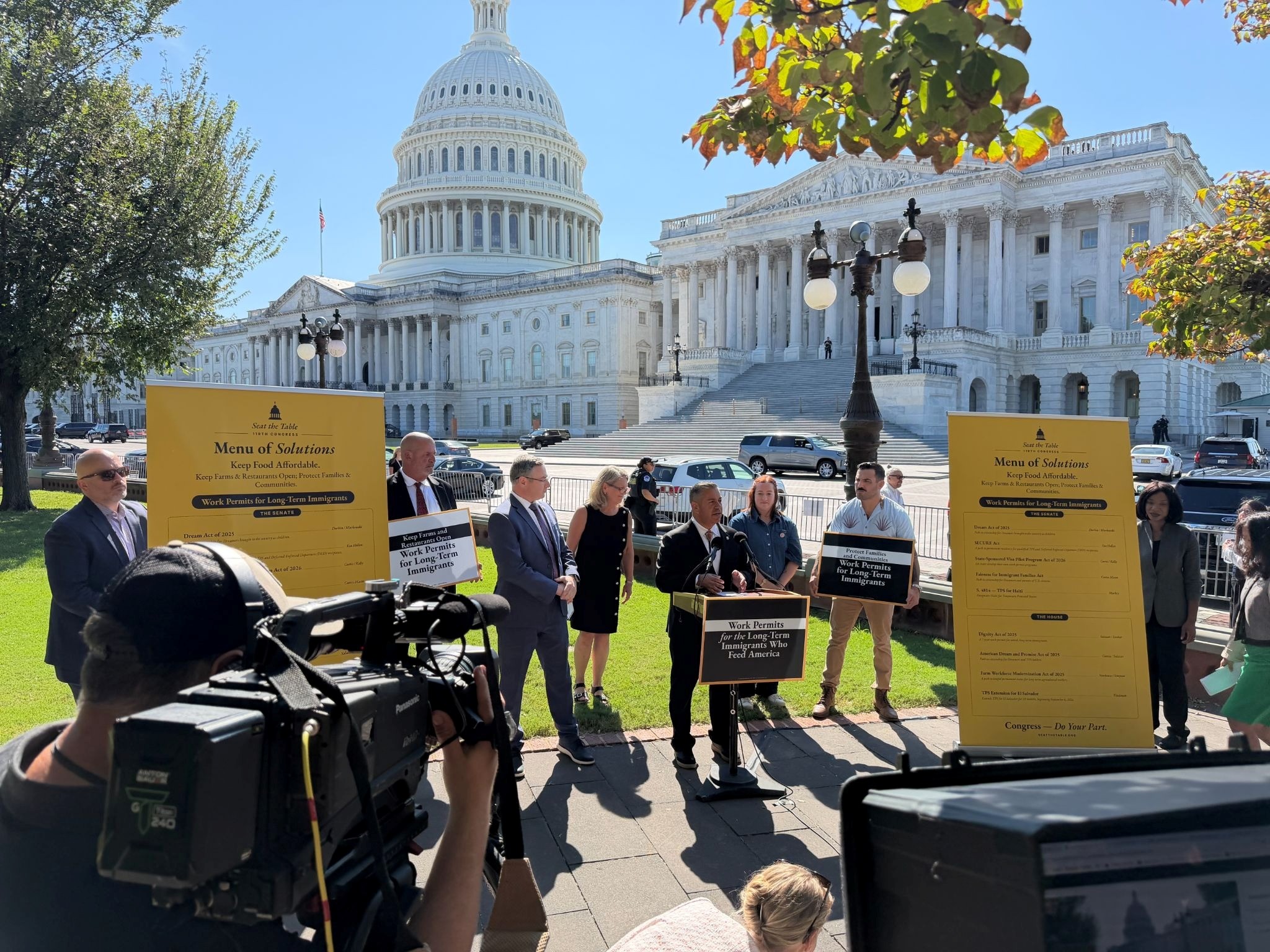
WASHINGTON, D.C. — U.S. Senators Dick Durbin (D-IL), Ben Ray Luján (D-NM) and Chris Van Hollen (D-MD) and U.S. Representative Eugene Vindman (D-VA-07) joined the James Beard Foundation, Independent Restaurant Coalition, Florida Restaurant and Lodging Association, American Business Immigration Coalition Action and other restaurant, food and business leaders from the Seat the Table coalition Tuesday to call on Congress to act in the November lame duck session on immigration solutions already on the table.
Standing beside a 7-foot-tall “menu” displaying legislative proposals currently pending before Congress, lawmakers and coalition members called for work permits and lasting certainty for long-term immigrants who have spent years working, paying taxes, and contributing to the U.S. economy. They warned that continued inaction will deepen workforce shortages, put further pressure on food prices and destabilize families and communities across the country.
The menu featured proposals already before Congress, including the Senate’s Dream Act of 2025 (Durbin-Murkowski), SECURE Act (Van Hollen), State-Sponsored Visa Pilot Program Act of 2026 (Kelly-Curtis), Fairness for Immigrant Families Act (Cortez-Masto), S. 4814 to extend TPS for Haiti (Markey). House proposals included the Dignity Act of 2025 (Escobar-Salazar), American Dream and Promise Act (Garcia-Salazar), Rep. Eugene Vindman’s recently-introduced bill to extend TPS for El Salvador and the Farm Workforce Modernization Act (Newhouse-Lofgren).
“We are standing behind a ‘Menu of Solutions’ to protect our workforce, ensure food affordability and safeguard workers, small businesses, families and communities. These options are already sitting here on Congress’s plate,” said Rebecca Shi, CEO of the American Business Immigration Coalition Action (ABIC Action). “From TPS holders to Dreamers to farmworkers, protecting long-term immigrants isn’t just morally right, it is economically essential, and it has everything to do with the price of your next meal. More than half of restaurant operators nationwide say current immigration policies are hurting their businesses. When we pull highly productive, long-term workers out of farms, packing plants, grocery stores and restaurant kitchens, there is simply no one to replace them. Congress and the White House, are you ready to order yet?”
“Without immigrants, we don’t eat, or we don’t eat as well, that’s for sure. And we know there are solutions,” said U.S. Senator Dick Durbin (D-IL), lead sponsor of the Dream Act of 2025. “I was part of the Gang of 8 more than a decade ago, four Democrats and four Republicans, and we passed comprehensive immigration reform through the Senate with more than 60 votes. We can solve these problems. People of good faith and reality can solve these problems. Are we out of time this year? Hell no, we’re not out of time. We can put a bill together and pass it in the Senate and the House in the remaining days left in this session.”
Speakers said long overdue congressional action would provide much-needed certainty for longtime residents and the employers that depend on their work. Continued delay, they warned, will deepen the economic consequences of an enforcement-only approach to immigration that a majority of Americans reject.
“This should not be hard. Democrats and Republicans, take a look at the menu, see which one you want to vote for and let’s get after it,” said U.S. Senator Ben Ray Luján (D-NM). “Each and every one of these pieces of legislation will make a positive difference in the lives of Americans and in the health of our economy. Farmers, ranchers and restaurant owners in New Mexico are telling me they are worried about their workforce, and workers are afraid to show up because of immigration enforcement. Let’s pass some work permit legislation. Let’s work together and, as has been pointed out today, just pick one. If you’re brave enough, support them all.”
“The SECURE Act provides important certainty and stability to people who are here on TPS, people who have legal status, undergo regular background checks and have been important parts of our communities,” said U.S. Senator Chris Van Hollen (D-MD), lead sponsor of the SECURE Act. “We tried to pass the SECURE Act on the Senate floor just a few weeks ago, and we’re going to keep pushing. We’re not going to give up on the immigrant community, and we’re not going to give up on finding solutions Congress can act on.”
Speakers pointed to the uncertainty facing TPS holders as a clear example of why Congress must act swiftly to provide lasting certainty through legislation. The Department of Homeland Security’s announcement last week about Temporary Protected Status for El Salvador avoided the immediate termination of protections for the more than 150,000 workers from the country, but left their families and employers without a clear timeline or decision about the program’s future. Haitian TPS holders, meanwhile, have already lost protections and face detention and deportation, resulting in significant disruptions across critical industries, including restaurants, healthcare and senior care.
“Today’s unclear and uncertain reality that Salvadorans are living with is unacceptable. Our friends and neighbors are living in fear, uncertain of what will come next,” said U.S. Representative Eugene Vindman (D-VA-07). “That’s exactly why I introduced legislation to extend Salvadoran TPS and employment authorization for the next 18 months. Just last week, I visited a business in my district where the owner told me he was facing the prospect of letting go of workers who had been with his company for 25 or 30 years. These are people who have spouses and children, who have built their lives in America and contribute to our communities and economy every day. I will continue fighting for them and for the American dream.”
“People aren’t showing up for work because they are scared. I’ve seen businesses in my town change their hours because they simply don’t have the help, and I’ve seen hotels take rooms offline because they cannot service them,” said Bill Lay, Restaurant Owner in Key West, Florida, and Member of the Florida Restaurant and Lodging Association. “Key West has a population of about 25,000, our Haitian community makes up roughly 20% of that population and more than 60% of the workforce, and we serve 3.5 million tourists a year. The economic impact is real and it is happening right now. I am a Republican, but I’m not here for politics. I’m here to find common ground and a humane way forward for everyone. We have solutions here before us. Congress, it’s time to act.”
For restaurants and the food industry, the compounding consequences of congressional inaction and an enforcement-only approach are already being felt. Food prices are already 35% higher than before the COVID-19 pandemic, with restaurant owners directly citing recent immigration policy changes as having negatively impacted their businesses. Food and business leaders warned that removing experienced workers from restaurants, farms, food manufacturing facilities and grocery stores would deepen labor shortages, disrupt operations and place further upward pressure on prices.
“Immigrants are central to our food and restaurant ecosystem, represented not just throughout the industry but among our James Beard Award winners, program alumni and chef advocates across the country,” said Ellen S. Teller, Chief Government Affairs Officer at the Food Research & Action Center and a member of the James Beard Foundation Board of Directors. “Today, alongside our partners in the Seat the Table coalition, we urge Congress to provide work permits for long-term immigrants to help protect food affordability, strengthen the economy and support families and communities. Without work permits for immigrants, restaurants will close, jobs will be lost and communities will lose cherished, hardworking immigrant members.”
Restaurant leaders described how immigration enforcement has disrupted operations and created a climate of fear, contributing to the loss of experienced employees, declining customer traffic and greater strain on businesses already operating on thin margins.
“These are not just numbers, they are families. They have built their lives here, raised their families here, and their children go to school with our children,” said Carlos Raba, Chef and Owner of Clavel Restaurant in Baltimore. “They work, pay taxes, own businesses and help build our communities every day. Hospitality is one of Maryland’s most important industries, supporting more than 240,000 jobs, and immigrant workers are a major part of that industry. Without them, our restaurants and hospitality businesses simply could not operate the way they do today. If we lose these people, the impact on our communities and our economy will be enormous. This is not just a TPS issue, this is a community issue.”
“More than one in five restaurant workers in this country was born outside the United States, and restaurant work is skilled work and must be recognized as such,” said Codi Bates, Owner of Bates & Co. Hospitality and Vice President of the Independent Restaurant Coalition. “Cooks and kitchen managers develop their expertise over years, train other employees and carry the knowledge and experience that restaurants depend on, yet our current immigration system often fails to recognize that reality. We need practical reforms that recognize experienced culinary and hospitality professionals as skilled workers and create lawful, affordable hiring pathways that actually work for small businesses. When people have the stability and opportunity to build their futures, families and communities are stronger, and so are the independent restaurants that are part of them.”
Tuesday’s event marked the latest step in Seat the Table’s national push to move Congress from debate to action. The coalition has grown to more than 100 members from all 50 states, and in weeks ahead, restaurant owners, food businesses and immigrant families will continue pressing lawmakers to choose among the solutions already before them and act by November.
Photos and additional materials are available upon request.
###
About ABIC Action
ABIC Action represents more than 1,700 employers, from Fortune 500 companies and family farms to small businesses across the country. ABIC Action advocates for immigration reforms that secure the border, stabilize the workforce, lower costs and create legal pathways for immigrants already contributing to the country.
About Seat the Table
Seat the Table is a nationwide coalition of food, agriculture and hospitality leaders founded by American Business Immigration Coalition Action, the James Beard Foundation, the Texas Restaurant Association and the Independent Restaurant Coalition. The coalition, which has grown to include more than 100 members from all 50 states, advocates for practical work permit solutions for long-term immigrants that protect America’s food supply, workforce and consumers from further cost increases.