Securing Your Payments Processing

October marks the two-year anniversary of the U.S. migration to EMV smart-chip enabled payment technology. Despite the fact that the migration was accompanied by a card-present fraud liability shift to the party using the least secure technology, Visa reports that only about 2 million U.S. merchants have transitioned to this new level of technology. This leaves nearly 67 percent of U.S. merchants vulnerable, as fraudsters turn their focus to non-EMV enabled businesses.

EMV, which stands for Europay, MasterCard and Visa, is the global standard for cards equipped with computer chips and the technology used to authenticate chip-card transactions. EMV cards are embedded with a smart chip that creates a unique transaction code that cannot be used again, improving the payment security for consumers.

How criminals take advantage
According to the Verizon 2017 Data Breach Investigations Report, Accommodation and Food Services was “the top industry for Point of Sale intrusions.” While this isn’t a new problem – hotels and restaurants have been plagued by counterfeit, stolen and cloned credit card activity for years – the liability shift has further highlighted the issue.

Criminals prefer magnetic strip cards. When criminals purchase credit card numbers, the data – regardless if it is magstripe only or EMV technology – is loaded on a standard magstripe counterfeit card. If they attempt to use the counterfeit card as an EMV-enabled terminal, the terminal can detect that the card being used has EMV capabilities and the system will prompt the fraudster to “dip” the card instead of swiping. Attempts to process the transaction without “dipping” the EMV enabled card will be declined.

Some fraudsters have been scamming your businesses for years without you knowing about it because, previous to the liability shift, the issuing bank was taking the loss. All the scammer has to do now is call the credit card company after their card is swiped at an old terminal and claim the charges on their chip-enabled card weren’t accurate, leaving you to empty your pockets. While the chargeback amount may not be big, it wouldn’t take many of these false chargebacks to really cut into your profits. Without the ability to accept EMV transactions, business owners are seeing liability shift chargebacks for which there is no defense.

If upgrading to EMV simply isn’t an option for your business, here are a few tips you can use to protect yourself from fraudsters.

• Verify that the last four digits of the card number match the last four digits on the printed receipt
• Compare the signatures on the card and receipt
• Check cards for legitimate features like holograms, logos, CVV/CID/CVV2 and AVS verification, etc.
• Never rerun a card if it declines – for any reason

Comprehensive Coverage
EMV chip technology improves security by providing card authentication. However, the most advanced credit card thieves can rewrite the magstripe, tricking even new EMV chip-reading machines to think the card is chipless when swiped. If you have purchased the EMV card-reading equipment, but are not encrypting transactions as part of your upgrade, your business may still be at risk. While EMV-enabled terminals offer increased security and reduces credit card fraud, you need to employ a comprehensive approach for the best security.

• Tokenization – replacing card data with a “token” protects card data while at rest in your POS system. This is particularly imperative in a hotel environment, where customer data is typically stored for days, weeks or even years. Even if your system is hacked, tokenization makes the data stored in it unusable to cybercriminals.

• End-to-end Encryption – this powerful technology removes card data from the merchant’s network, protecting the data in transit so it cannot be intercepted or monetized.

• Incident Management Program – According to the Association of Certified Fraud Examiners, nearly 50 percent of small businesses fall victim to fraud as some point in their business life cycle. Every business should have a plan in place for how they will handle an incident, should one occur. Containing the breach, responding quickly and communicating appropriately is the best way to prevent reputation damage and stem losses.

Heartland Secure combines EMV, tokenization and end-to-end encryption together to give your business the most comprehensive security solution on the market. We are so confident in our ability to protect credit card data the moment it is used, we offer an unprecedented breach warranty to all merchants who are Heartland Secure and employ Heartland Secure-certified devices for as long as they are processing with Heartland, at no additional cost.

To learn how Heartland Secure could help your business protect against fraud, contact Angela Ihry
at [email protected].

First Quarter of 2017 Sets Florida Visitation Record

Florida tourism set another record by welcoming the highest number of quarterly visitors in the state’s history with 31.1 million in the first quarter of 2017. This represents a 2.5 percent increase over the same period in 2016. To add to this great news, during the recent special session called by Governor Scott, the Legislature allocated $76 million to fully fund VISIT FLORIDA to continue to market Florida as a premier vacation destination worldwide.

Governor Scott said, “I called a special session to fight for jobs, tourism and education, and I am proud to announce a major win for Florida families. This special session, we’ve increased the per-pupil spending to an all-time high, we’ve established a flexible, transparent economic development program and we’ve fully funded VISIT FLORIDA so we can continue to break visitation records. We know that the most important things to a family are a good-paying job and a great education for their children, and these major investments will help us continue to create opportunities across our state for generations to come.”

VISIT FLORIDA President & CEO Ken Lawson said, “This victory would not have been possible without the help of the Governor, the Legislature and all of our Industry Partners. Thanks to your dedication and support, VISIT FLORIDA is now fully funded and we can continue aggressively marketing our state to visitors around the world. With Governor Scott leading the way, Partners such as Jungle Island, Sawgrass Recreation Park, Medieval Times, ResortQuest and thousands more can continue attracting record numbers of visitors to businesses across the state. I am forever grateful for your hard work.”

Estimates from VISIT FLORIDA show a record 27.1 million domestic visitors traveled to Florida in Q1 2017, reflecting a 3.2 percent increase over the same period last year. Estimates also show that 2.7 million overseas visitors and 1.3 million Canadians came to the Sunshine State in January-March 2017. Total enplanements at Florida’s 18 major airports in Q1 2017 increased 1.6 percent over the same period the previous year, with a record 22.7 million enplaned passengers. For Q1 2017, the number of rooms sold grew by 2.2 percent and the hotel occupancy rate rose 0.7 percent compared to Q1 2016.

Florida Restaurant & Lodging Association President & CEO Carol Dover said, “Florida’s hospitality industry is thrilled our elected leaders coalesced to invest in VISIT FLORIDA. The overall health of Florida’s economy depends on visitors selecting the Sunshine State as their leading destination. With 31.1 million visitors in the first quarter of 2017, this optimal funding builds on the state’s marketing momentum and attracts commerce that benefits local businesses and state revenues.”

Meet VISIT FLORIDA’s New President & CEO Ken Lawson

For this legislative issue of Florida Restaurant and Lodging Magazine, VISIT FLORIDA would like to introduce you to our new President & CEO Ken Lawson.
 
Ken, who was the unanimous selection of the VISIT FLORIDA Board of Directors, assumed his new role on January 11.  A native Floridian and former U.S. Marine Corps Judge Advocate General, he has spent 12 years serving and protecting the public in numerous regulatory positions, including his most recent work overseeing—among other divisions—restaurants, hotels and vacation rentals with the Florida Department of Business & Professional Regulation (DBPR).  During his six-year tenure with them, he managed a team of 1,600 employees charged with licensing and regulating more than 1 million businesses and professionals throughout the state.
 
In a message to the industry he sent on his first day, Ken outlined his plan for the near term.
 
“In the days to come, I will be meeting with each of my new staff individually to hear their ideas for moving forward successfully.  I will be personally reviewing all aspects of the day to day operations of this great organization to ensure we are fully accountable to the Governor, the Legislature and the taxpayers of Florida in all our endeavors.
 
In the weeks and months ahead, I will be traveling the state to meet with our industry Partners to better understand what they need from VISIT FLORIDA.  I will also be walking the halls of the Florida Capitol to speak directly with legislators about the vital role VISIT FLORIDA plays in growing the state’s economy by increasing tourism revenue.”
 
He concluded by stating, “VISIT FLORIDA and the entire Florida tourism industry have a great deal to be proud of with five years of record visitation, visitor spending and tourism-related employment.  I want to work closely with you all to take that unprecedented growth to the next level.  I value the input and expertise of our industry leaders and Partners, and would be happy to hear from you at [email protected].”
 
Carol Dover, both the President and CEO of the Florida Restaurant & Lodging Association and a member of the VISIT FLORIDA Board of Directors, said “Ken will be a tremendous asset to VISIT FLORIDA and ensures the organization will be well-positioned to continue to play a key role in promoting the state to visitors around the globe.  VISIT FLORIDA needs a CEO with his impeccable capabilities and strong sense of responsibility to the public sector, and I am honored and privileged that he has agreed to take this significant leadership role.”

VISIT FLORIDA Puts the Power of Discovery in the User’s Hands

VISIT FLORIDA first launched the Florida Beach Finder online search tool in 2014 as a way to showcase the state’s beaches to visitors from around the globe. Here’s how it works: Visitors can “tune” their preferences in four ranges of beach personalities. Looking for action-packed, secluded or maybe somewhere in between? The Florida Beach Finder immediately delivers visual choices that best match users’ desires. With every tweak of the tuner, the options change before their eyes.

Visit Florida Beach Finder

Next, they can “walk” the Florida beaches they love with immersive Street View imagery in Google Maps. In one of the first partnerships of the Street View Trekker Loan Program, VISIT FLORIDA and Google collaborated to train and equip our local teams with their high-tech, 40-pound, backpack-mounted, 360-degree panoramic camera. Over the four months of the project, these teams took nearly 15 million pictures as they trekked Florida’s 825 miles of beaches. The same technology that lets viewers mouse around their city streets and tour monuments now empowers Florida beach lovers to view the sand, sky and shorelines of the beaches they choose to explore – all in 360-degree panorama. To date, the Florida Beach Finder has attracted more than 260 million views on Google and VISITFLORIDA.com.


Visit Florida Attractions FinderThe success of the Florida Beach Finder prompted VISIT FLORIDA to create another finder on the TripTuner platform which launched in May – this time featuring the state’s unique and diverse attractions. Similar to the Beach Finder, the Florida Attractions Finder has four separate settings that can be adjusted depending on the user’s vacation preferences: from thrill to chill, popular to hidden gem, high-tech to natural, and days to hours.

The interface then matches the user with an attraction, which could be an internationally recognized theme park or an off-the-beaten path experience. Point-of-view videos send users careening and diving on the newest roller coasters, zip-lining over alligators or skimming the Everglades aboard an airboat. Whether visitors are looking for a first-time Florida experience or wishing to repeat their favorite Florida vacation moment, the Florida Attractions Finder puts the power of discovery in the user’s hands.

The goal of the Finders is two-fold – to give people an immersive and highly-visual sampling of Florida’s diverse offerings and entice them to experience it for themselves by planning the exact vacation they’ve always wanted.

To view for yourself, go to VISITFLORIDA.com/beachfinder and VISITFLORIDA.com/attractionsfinder.

Stay tuned, VISIT FLORIDA hopes to create additional Finders that will showcase Florida’s wide array of dining and lodging options.

Small Business Saturday — Another Record Breaking Year!

THANK YOU for all your amazing help and support for Small Business Saturday 2016.  The numbers, especially the record number of shoppers, say it all.  By hundreds of us coming together to support small businesses, we achieved amazing results. Congratulations to everyone on an incredible job!   The attached press release provides a more complete summary of the success; however, we thought you would like to see a few of the key results.
 

Small Business Saturday key result: 112 million consumers shop and dine – more than ever before
•As Small Business Saturday wrapped up its seventh year on Saturday, November 26th, the outpouring of support for local businesses across the country hit record highs with 72% of U.S. consumers aware of the day.
•This year, an estimated 112 million consumers reported shopping at small businesses on Small Business Saturday, marking a 13 percent increase from 2015.
•More than 6,700 Neighborhood Champions from the Great Lakes to the Gulf Coast and from the Pacific Northwest to New England rallied local businesses and created events in their communities for Small Business Saturday — an increase of 63 percent over last year.
•Additionally, the estimated number of small business owners reached through the Neighborhood Champion program was 2.1 million.
•More than 480 organizations joined the Small Business Saturday Coalition, a 13 percent increase over last year.
•Consumers came together to show their love for small businesses on Small Business Saturday. Among those who shopped on the day, 32% reported attending a community event, and 81% reported encouraging friends or family to shop or dine at small, independently-owned retailers and restaurants on the day as well, both on par with 2015.
 

Elected Officials across the U.S. Show Their Support
•President Obama issued a letter recognizing Small Business Saturday in 2016.
•Elected officials in all 50 states and Washington, D.C. championed Small Business Saturday.
•A total of 288 Federal Officials and Agencies showed support for Small Business Saturday through posts on Facebook and Twitter.
•The United States Senate unanimously passed a resolution designating November 26th, 2016, as Small Business Saturday.
•651 City proclamations in support of Small Business Saturday were issued by mayors and other elected officials in all 50 states and Washington, D.C.
•Nine Public Service Announcements encouraging the public to “Shop Small” were recorded by government officials across the nation.
 

Thank you again for your amazing work in making Small Business Saturday a success.   Have a great holiday season and remember to #ShopSmall!


Florida Restaurant and Lodging Association (FRLA) lends its support to Small Business Saturday® and drives commerce to small businesses

2016bannerfp300x250


FRLA proudly supports this year’s Small Business Saturday, taking place on November 26th. Small Business Saturday is a day dedicated to supporting local small businesses and strengthening and celebrating communities across the country.


Created by American Express in 2010, Small Business Saturday serves as the ceremonial kickoff to the holiday shopping season for small businesses across the United States. In 2015, 95 million consumers shopped at small businesses on Small Business Saturday and spent an estimated $16.2 billion at independent retailers and restaurants on the day, according to the 2015 Small Business Saturday Consumer Insights Survey.1 The day was also championed by elected officials in all 50 states and Washington, D.C., including President Obama.


The Florida Restaurant and Lodging Association (FRLA) recognizes the importance of supporting small businesses, the jobs they help create, and the culture they instill in local communities. According to the U.S. Small Businesses Administration, as of 2014, small businesses nationwide accounted for 63% of net new private-sector jobs created and represented 99.7% of firms with paid employees.2


Merchants and consumers can learn more about Small Business Saturday and how to get involved by visiting ShopSmall.com.


ABOUT SMALL BUSINESS SATURDAY


November 26th marks the seventh annual Small Business Saturday, a day to support the small businesses that can create jobs, boost the economy and preserve neighborhoods around the country. Small Business Saturday was created in 2010 in response to small business owners’ most pressing need: more customers.


1Estimates are based on consumer self-reported data from the Small Business Saturday Consumer Insights Survey by National Federation of Independent Business (NFIB) and American Express (November 30, 2015) and do not reflect actual receipts or sales.
2Small Business Administration Office of Advocacy Frequently Asked Questions, March 2014

SMALL BUSINESS SATURDAY IS NOV 26

2016bannerfp728x90

The Florida Restaurant and Lodging Association is proud to support Small Business Saturday®, the day founded in 2010 to celebrate small local businesses.  This year, even more resources are available to help make November 26 a day to remember for your business.


Get involved in the day and help get more customers in your door. The new Shop Small® Studio is a one-stop destination for your promotional needs, including materials for your storefront, website and social networks. You can even create customized marketing materials for your business, and download them for free!


Tap into knowledge. Small Business Saturday 101 offers tips and insights from business owners and people in the know to help make the most of your promotional materials.


Visit ShopSmall.com/GetReady. Access Small Business Saturday resources and create FREE custom downloadable marketing materials.
Be part of Small Business Saturday 2016 and help your community thrive.
Go HERE to learn more.

Get Familiar with VISITFLORIDA.org: A One-Stop Resource for Marketing and Industry Education

VISITFLORIDA.org, unlike VISITFLORIDA.com, is a website designed exclusively for the Florida tourism industry.  The site was created to provide marketing guidance and education for VISIT FLORIDA Partners and easily showcases ways tourism businesses can enhance their exposure to visitors.
 
A key feature of the site is the Online Marketing Planner, which serves as a resource for the industry to participate in VISIT FLORIDA officially-sanctioned co-op programs, including advertising, sales, public relations, promotions, welcome centers and industry education.  Since its inception in 2009, the Marketing Planner has proven to be a vital tool for the Florida tourism industry to promote their businesses and take full advantage of all available cost saving opportunities.
 
With more than 200 programs listed, the Planner makes it easy to create your own customized marketing plan.  As new co-op programs become available, the information is added to the Planner program list, which can be sorted by program type, audience, market and media channel.  The Planner also has a “My Plan” button with shopping cart functionality that allows you to view, save and print a customized plan.  Many of the items on the Planner offer a discount for VISIT FLORIDA Marketing Partners.  To learn more, go to VISITFLORIDA.org/planner.
 
VISITFLORIDA.org also offers helpful information on a host of other topics, such as:
 
Crisis Preparation – Includes FAQs and other information about preparing for or responding to specific potential crisis situations that could impact Florida tourism entities
Order FREE Maps and Magazines – Complimentary bulk orders of Official Florida Vacation Guides and Florida Transportation Maps
Research – Includes FAQs about visitation, the Florida Visitor Study, the Power of Florida Tourism infographic and a Florida Tourism by the Numbers PowerPoint presentation that the industry is welcome to use
Education – Participate in FREE Online Hospitality Training and listen to recorded webinars in the Learning Library
About Us – Includes digital versions of VISIT FLORIDA’s Strategic Plan, Marketing Plan and interactive Annual Reports
 
Additional resources available on the site are exclusive to Marketing Partners, such as image and VISIT FLORIDA logo downloads, the ability to submit images for posts on VISIT FLORIDA consumer-facing social media channels, and the opportunity to share Partner-to-Partner specials.
 
For more information about becoming a Marketing Partner, go to VISITFLORIDA.org/join.  To enroll today, call the VISIT FLORIDA industry hotline at 877-435-2872 or email [email protected].

What is a Raw or Undercooked Egg?

When your foodservice customers order eggs sunny-side up, scrambled, or in an omelet, are you putting them at risk for foodborne illness?

Cooked eggs may not reach a temperature that destroys viruses such as avian influenza or bacteria such as Salmonella enteritidis. Your foodservice kitchen may even be using raw eggs in Hollandaise sauce or Caesar salad dressing, introducing foodborne illness risks to your guests. Read more facts about Salmonella and eggs in the Field Guide to Egg Safety.

When is an egg safe from Salmonella?

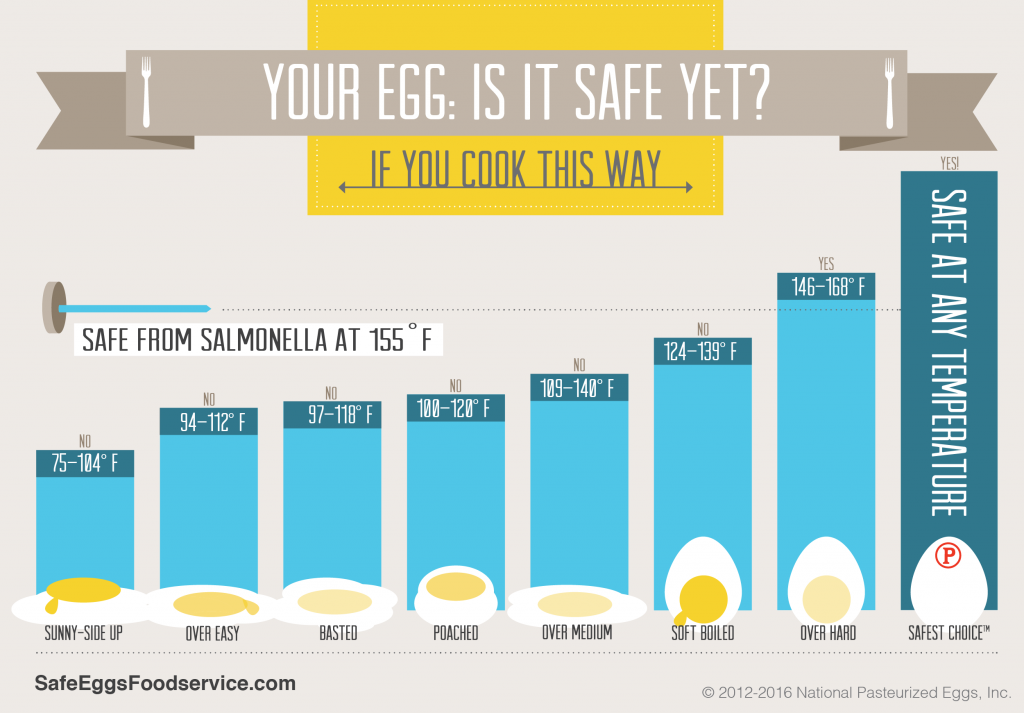
So, at what temperature is an egg no longer considered “raw” or “undercooked”? An egg is considered fully cooked—that is, safe from foodborne illness—when it has reached a temperature of 155°F for pooled, hot holding or for later service. Over hard eggs, for example, have reached this temperature. However, foodservice customers are far more likely to order eggs sunny-side up. Eggs served this way represent the lowest cooked temperature of any egg option, only reaching a temperature between 75°F and 104°F.

Egg Temperature image
Balancing safe egg temperature and quality

Omelets and scrambled eggs are also common culprits in Salmonella enteritidis outbreaks. Your foodservice guests don’t want dry, rubbery eggs, but cooking them softer carries with it the risk of Salmonella contamination. The fact is, the majority of the ways foodservice operations prepare eggs do not result in fully-cooked eggs.

Salmonella, eggs, and the CDC

The number of Salmonella outbreaks originating from foodservice kitchens is the reason the CDC pays special attention to how eggs are stored, prepared, and staged in foodservice kitchens. The CDC says dangerous egg-handling procedures are putting foodservice guests at risk of foodborne illness. They urge foodservice operators to use pasteurized shell eggs. Read more: CDC “Cracks Down” on Unpasteurized Eggs in Restaurants.

Pasteurized shell eggs—safe at any temperature

Currently, only about 1 in 5 restaurants uses pasteurized eggs, according to the CDC. Because the FDA does not consider pasteurized shell eggs a TCS (potentially hazardous) food, Davidson’s Safest Choice® pasteurized shell eggs greatly simplify your egg HACCP plan, help you stay in regulatory compliance, and allow you to safely serve eggs in your foodservice operation any style your customers want.

Exclusive Health Care Pricing and Solutions from UnitedHealthcare

UHC Slider

Because health care is a top concern for businesses like yours and to help meet your needs, the Florida Restaurant & Lodging Association (FRLA) and the National Restaurant Association (NRA) are working with UnitedHealthcare to provide easier access to health care coverage and related products and services.

UnitedHealthcare, the FRLA and the NRA offer an exclusive program to members, featuring:

  • Up to a 5 percent discount on medical rates for fully insured groups with 51 or more eligible employees
  • Annual invoice credit of up to 5 percent on administrative fees for new ASO medical products for self-funded groups with 100 or more eligible employees
  • Up to a 5 percent discount on specialty benefits products (dental, vision, life and disability) for fully insured groups – in addition to all other discounts including the Packaged Savings® program
  • Wellness programs and services aimed at helping people live healthier lives
  • Access to the National Restaurant Association Notification Tool, which helps employers meet the exchange notification law requirements from the ACA with notice templates from the U.S. Department of Labor and the ability to track employee health care law verification records
  • Latino Health Solutions resources and tools for Latino/Hispanic owners, operators and employees through UnitedHealthcare’s PlanBien® program
  • Lower-cost “preventive” medical plans that meet minimal essential coverage requirements for the Individual Mandate under the ACA for self-funded groups with 100 or more eligible employees

The NRA and the FRLA chose to work with UnitedHealthcare because of its wide range of innovative products and services to address the diverse health care needs of hospitality industry employers, employees and their families.

UnitedHealthcare offers access to its expansive network of health care providers and services, online tools, and a range of wellness programs. In addition, voluntary benefit programs are available for dental, vision, life and disability insurance products.

This UnitedHealthcare alliance program is designed exclusively for the hospitality industry to meet your health and wellness needs.

Interested in learning more? Visit www.uhctogether.com/frla.

Some restrictions apply; and discounts may vary by location and group size.

Insurance coverage provided by or through UnitedHealthcare Insurance Company or its affiliates. Administrative services provided by United HealthCare Services, Inc. or their affiliates. Health Plan coverage provided by or through a UnitedHealthcare company.