Serving Up Our February Member of the Month

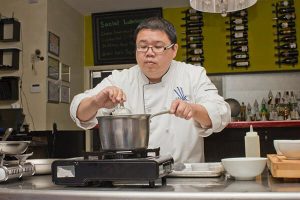
We are excited to introduce Dennis Chan, owner of the delicious Blue Bamboo restaurant in Jacksonville. Dennis comes from a long line of chefs, and knew it was his legacy to continue serving food and carry on his family’s traditions.

One of his favorite things about working in the restaurant business and hospitality industry is the ability to use his food and excellent service to brighten someone’s day.

“You never know if you’re going to have a guest come in who is having a bad day and you need to turn them around, or they’re just having a great day and coming out to celebrate.”

Dennis is a long-standing, second-generation member of FRLA and is committed to helping aspiring restaurateurs. He teaches culinary classes at local schools and volunteers with ProStart on a regular basis. Thank you, Dennis, for your continuous support of FRLA and all you do for your community.

Next time you stop by Blue Bamboo, we suggest you try the Sunshine State Orange Crunch Cake Cake!

Check out Dennis’ Member of the Month video below:

Know someone you think should be our FRLA Member of the Month? Nominate them here.

There’s Room for Everyone Under the MO+S Umbrella

We’ve attended the FRLA Marketing + Operations Summit since its inception. In fact, we’ve found this event to be so valuable and important that we’ve been a sponsor for the past three years.

M+OS is more than an opportunity to hear about the latest and greatest trends in the hospitality industry with regard to marketing and operations issues. The Summit helps us stay current with the challenges our customers face and gives us specific topics to discuss with them throughout the year.

We’ve learned countless tips and tricks in our years of attending the Summit, but I will never forget participating in a Breakout Session focusing on how to market to various generations when we had a lightbulb moment. Each year, we gain real-life lessons, and this one convinced us to hire a social media staffer. Thanks to this realization, we’ve seen a significant uptick in our online interactions with existing and, most excitingly, new customers. Incorporating such a simple tactic into our marketing strategy allowed us to reach more people.

The Summit provides us with an opportunity to network with members who could one day be potential customers. Through our networking over the years, we’ve found it crucial to learn what customers are trying to accomplish so we can work with them to support their efforts. For example, we can assist in combining a restaurant’s marketing and operational goals by offering custom logos imprinted on their umbrella canopies. Operationally, their guests receive the comfort of shade and may stay at the table longer, ordering coffee and dessert, thereby increasing the bottom line.

It’s been our experience that the Summit is a great place to learn from industry veterans, find out what innovative, best practices are out there, and how different successful brands have overcome challenges. The quality of the speakers is fantastic – from famous chefs like Robert Irvine, to entrepreneurs and restaurant executives from Firehouse Subs and Tijuana Flats. Both the networking opportunities and the chance to meet with decision makers across the industry are terrific. We are looking forward to what this year has in store!


This week’s blog comes from Jordan Beckner, President of Sales at FiberBuilt Umbrellas & Cushions.

Have Your Say on Tourism Day

On March 13th, movers and shakers of the tourism industry are heading to Tallahassee from all over Florida for Tourism Day.

Why it’s important

This yearly event allows industry professionals to let lawmakers know the importance of tourism in our state and in their businesses. Tourism day is dedicated to bringing those in the tourism industry and government officials together. This event is organized by Visit Florida and FRLA, and allows attendees to meet face-to-face with their legislative representative and voice their opinions and concerns.

What to expect

At Tourism Day, attendees can expect to receive lots of information from policy makers and state leaders. This day allows for direct interaction with legislators in a fruitful environment. Outside of connecting with legislators, attendees can network with industry professionals from across the state to share ideas, industry issues, and more with one another. This is an exciting and fun day for those in the tourism and hospitality industry.

Added benefits

This event displays the enormous scope and breadth of the industry. It is alive and well in all corners of the state, from the smallest restauarant to the largest hotel. It can feel as though people often take this industry for granted and discount its importance. We employ millions of people, and we are responsible for billions in sales. This event brings all aspects of the industry together, and there is power in that.

Ready to have your say on Tourism Day? Register here.


Be Flexible: An Alternative to Plastic Straw Bans

Straws don’t suck… but littering does. Issues regarding improperly discarded plastic straws have many concerned about the potential impact on Florida’s waterways and environment. Florida’s incredible rivers, streams, beaches, flora, and fauna are some of the state’s greatest assets for residents and visitors alike, so it makes sense for those in the hospitality industry to be committed to ensuring our environment stays healthy. Many have chosen to be proactive in their local communities by participating in voluntary straw bans or request-only campaigns where the business doesn’t give a straw unless it’s requested by the customer.


The Challenge for Hospitality Businesses

Several local government entities across the state have chosen to adopt regulations, restrictions, and bans on plastic straws. As is often the case with local regulations, they have similar provisions, but few are exactly alike. This leaves businesses that operate in multiple locations to keep up with the intricacies of each regulation. The differences can be both confusing and burdensome for businesses to accommodate.

Every business should be free to serve its customers in the lawful manner in which it sees fit. Some companies decide that providing disposable items such as straws does not fit with their culture and identity. Others may take a different approach, and there is space for both in Florida.

Plastic straws are not, in and of themselves, evil. In fact, they serve very real and positive purposes. Straws provide necessary assistance to individuals with disabilities who may need them in order to consume their chosen beverage. Parents may choose straws to prevent in-car messes when feeding children on the go.


Be Flexible: An Alternative to Banning All Straws

So how do we strike a balance on straws? First, we must acknowledge that we each have a job as individuals to ensure the disposable items we use make it into the proper waste or recycling containers. No one believes a straw belongs on the ground or in the water, and proper disposal will help keep these items where they belong.

Second, an outright ban might not always be the answer for every customer. The hospitality industry, dedicated to the service of customers and guests, can use a two-pronged approach to meet the needs of all.

First, adopt a policy of request-only. Have plastic straws available but provide them only on request of the customer. This will significantly reduce the distribution of straws. Customers who need them will ask for them, and those who don’t need them won’t receive them automatically only to throw them away.

Second, allow for use of straws made of alternative materials. There is an increased availability of straws made by other materials such as paper, metal, bamboo, and even pasta. These are great alternatives, and many businesses may find that they serve their customers well. We should be mindful, though, that alternative materials may not be suitable for all beverages. Allow businesses to decide if these alternative materials will be satisfactory to customers, and encourage and allow for the use.

By working together and making proactive choices, the hospitality industry can lead the charge on reducing the use and improper disposal of plastic straws. Blanket bans on straws are not the answer.


This week’s blog is written by Samantha Padgett, General Counsel for FRLA. For more information on our Government Relations team, please click here. You can find information about FRLA’s 2019 legislative priorities, including straw bans, here.
Meet our January Member of the Month


Meet Chip and Amanda Evans.

They are the proud owners of Willie Jewell’s Bar-B-Q in Tallahassee, Florida, and FRLA’s first ever Member of the Month.

These members have been actively engaged in FRLA since they joined in June 2018. With a passion for giving back, Chip and Amanda have taken advantage of FRLA’s involvement in the community. Chip says, “We try and give whenever we can. FRLA has been good about plugging us in. This is where the opportunities to give are.”

In October 2018, Hurricane Michael devastated the Panhandle. Victims of this disaster were left homeless, without food, water, power, or clean clothes. Along with other FRLA members, Chip and Amanda headed to Marianna to provide hot, fresh food and necessities to the community members in need.

From help with the hurricane to volunteering time and food with Vet Events Tally and other organizations, Chip and Amanda always go the extra mile to give. Regional Director Nick Lowe noted that they are “members who understand what it really means to serve others.”

Thank you, Chip and Amanda, for all you do for FRLA and the community.

To see what they had to say about FRLA, check out their Member of the Month video below.


Table 16 Is Now a Temporary Office

Considerations for Transforming Your Bar or Restaurant into a Temporary Coworking Space

While “traditional” office coworking spaces have flourished for years, a new trend is emerging to transform restaurants, bars and lounges into coworking environments. Several companies are now focused on converting well-located, but underused restaurants and bars into daytime pop-up offices complete with accessible electrical outlets, high-speed Wi-Fi and complimentary coffee. Bar and restaurant owners benefit by receiving a passive source of income during a period of the day their space would otherwise sit empty. In an industry known for fierce competition and razor-thin margins, transforming into a temporary coworking space can net a bar or restaurant 20% or more in additional revenue. That extra cash can be a lifesaver for fledgling eateries facing steep competition, increasing rents and labor costs.

Since coworking operators do not need to spend significant funds reconstructing a restaurant, they are able to offer their customers lower membership fees than traditional office coworking operators. Working out of a high-end restaurant or lounge with soundproofing offers members a quiet respite from noisy, overcrowded coffee shops and offices. Meanwhile, coworking members offer restaurants and bars a built-in market for happy hour and dinner service.

The temporary coworking model has proven successful, but like any new venture, hospitality operators should consider the business and legal risks before agreeing to lease or sublease their space.

Many new businesses fail and coworking operations are no different. Prior to executing any agreement, restaurant and bar owners should perform their due diligence and consider the coworking operator’s experience, reputation and leadership. You want to work with reputable operators with successfully-operating locations. Ask to speak with the owners of those locations. Check if complaints have been filed against the coworking company with the state or local department of consumer affairs or chamber of commerce. You should consider staffing requirements. While the coworking operator should have its employees onsite during operating hours, you may also want your own managers present.

Working Out an Agreement

If your bar or restaurant leases its space, you should first review the lease prior to entering into any agreements. Most leases include language prohibiting subleasing without the landlord’s prior written consent. Where the lease strictly forbids subleasing, you may consider approaching the landlord to discuss an accommodation. Many landlords understand the difficulty of operating a consistently profitable bar or restaurant and would rather work with you than deal with a default and the additional expenses of re-renting a space.

Property owners can enter into a lease agreement with the coworking company or opt for a non-traditional structure such as a joint venture or licensing. Your agreement can incorporate profit-sharing but should also clearly delineate roles and responsibilities.

Regardless of the business structure, your agreement should require proof of the coworking company’s insurance coverage naming the bar or restaurant as an additional insured. The agreement should contain language indemnifying your bar or restaurant from liability arising from the acts of the coworking company and its customers.

Security for You and Your Guests

Restaurant and bar owners should also consider enhancing security and surveillance systems and ensure that any alterations to the space performed by the coworking company comply with applicable laws and regulations.

With the continued rise of the gig economy, temporary coworking spaces are exploding in popularity. A carefully drafted agreement with a coworking operator can help ensure a successful and profitable relationship for years to come.

Looking for more content like this? Check out the latest issue of the Florida Restaurant & Lodging magazine here.


This week’s blog was written by Herman R. Lipkis of Holland & Knight, a global law firm with more than 1,250 lawyers in 27 offices throughout the world. Established in Florida, the firm has eight offices throughout the Sunshine State and provides representation in litigation, business, real estate, and governmental law. Mr. Lipkis can be reached at [email protected].

SEO is Always on the Menu

Search Engine Optimization is a competitive and ever-changing landscape. Any article claiming to know the secrets can be out of date before it goes to print. There are, however, some SEO trends restaurants can’t ignore and some advice that seems increasingly evergreen.

Voice Search

One SEO trend for everyone, including restaurants, that’s becoming a de facto norm is voice search.  Voice search brings with it some new challenges. For example, a voice search tends to use different language than a typed search: we tend to construct proper sentences for Alexa and Siri instead of the two or three keywords we type in a browser. Fortunately, the things you can do to optimize for voice search are also the things you should be doing anyway.

Which restaurants are near me?

Searches for food and voice searches have some things in common: they are often localized, immediate and mobile-based. It is imperative that your restaurant have both a Google My Business listing and a fast, mobile-optimized website. Page speed has been a factor in search rankings for some time but indications are it is even more important for voice searches. A quicker, secure (HTTPS) more mobile-centric website will rank higher in any situation.

Mark it up.

No, I don’t mean raise your prices. I mean use the restaurant-specific markup from Schema.org. What’s that? It’s a way to indicate to search engines which pieces of standardized content they are reading. For example: hasMenu lets you specify if you publish a menu, and if so, whether it is a document or text. (Please don’t make potential clients zoom in to a photo of your menu that you took with your phone.) It even lets you specify whether you have different menus for lunch or dinner. Other examples include opening hours, payments accepted, address and which languages are spoken. All of these could help differentiate your listing in a voice search for a ‘local eatery that is open now, serving lunch’. When the user gets served the right menu for the time of day, your conversion chances will rise.

Curate Your Reputation

There is also schema mark up for customer reviews which, when implemented, can result in star ratings showing under your search listing. Imagine a search for ‘5-star restaurant near me.’’ If your site includes properly-marked review content, you’ll be in the running.

Of course, in all these searches, you’ll be competing with services such as Yelp!, which is why reputation management is a critical part of SEO. You need to be monitoring those reviews. Intervene with the negative ones, and foster the positive ones. Consider a service such as Yext for monitoring directories and external reviews. Manage them correctly and you can let Yelp! do the SEO work for you.

Looking for more content like this? Check out the latest issue of the Florida Restaurant & Lodging magazine here.


This week’s blog comes from Jeremy Spinks, Vice-President of Online Design at FRLA member BowStern Marketing Communications. BowStern is a fully-integrated marketing firm headquartered in Tallahassee and specializing in innovative, memorable, and results-driven campaigns for clients across the globe.

Florida Administrative Rules Govern Temporary Event Food Safety, Licensing

Temporary events have always been a part of the American culture. Fairs, carnivals, athletic contests, farmers’ markets and local celebrations all have one thing in common – a variety of available foods. Food vendors range from restaurateurs trying to increase revenue and brand exposure to home cooks hoping to develop businesses around family recipes.

Florida Administrative Rules define a temporary event as any event of 30 or fewer consecutive days, advertised and recognized in the community, where food is prepared, served or sold to the general public. The statutes and the rules also specify food safety guidelines and licensure requirements food vendors must follow.

Most events take place outdoors and portable facilities and equipment are permitted. The minimum requirements include:

  • Overhead protection
  • Dustless flooring
  • Potable water for cleaning and hand washing
  • Approved cleaner and sanitizer for food-contact surfaces
  • A hand-wash facility with soap and single-use towels,
  • Equipment to maintain food hot (135°F or above) or cold (41°F or below)
  • A food thermometer
  • The means to protect food from environmental contamination

If warewashing facilities are not available on site, an adequate supply of spare preparation and serving utensils must be present to replace in-use utensils that become soiled or contaminated. All food must be stored and prepared at the temporary event or in a licensed food establishment. Food prepared or stored in private homes is strictly prohibited.

Except for specific statutory exclusions, food vendors must obtain a license prior to operating at temporary events. Event sponsors are required to notify the Division of Hotels and Restaurants at least three days prior to the start of the event. Division staff issue licenses on the event day after conducting a satisfactory inspection.

Fixed and mobile public food-service establishments with a current license from the Division of Hotels and Restaurants, or the Florida Department of Agriculture and Consumer Services, may operate one unit at an event without obtaining a temporary-event license. Single-event license fees are $91 for one- to three-day events and $105 for four- to 30-day events. A $456 annual license is also available and can be used to participate in multiple events.

Licensing exclusions include:

  • Events held on property regulated by Florida Department of Health, on Native American Indians sovereign land, or on church property
  • Events lasting one to three days and sponsored by a nonprofit organization
  • Food stands operated by a nonprofit organization
  • Vendors offering only ice, popcorn, whole fruits, peanuts in the shell, prepackaged items and beverages without additions or further preparation

Food vendors, including those excluded from licensing, must follow all sanitation and safety requirements to protect public health. A temporary-event brochure and checklist published by the Division of Hotels and Restaurants is available on DBPR’s website at www.myfloridalicense.com/dbpr/hotels-restaurants.

Read more food safety articles in FR&L Magazine’s Food Safety Edition.


This week’s blog is by Carlos Lezcano, Statewide Training Manager, and Lisa Lambert, Training and Research Consultant, at the Division of Hotels and Restaurants, Florida Department of Business and Professional Regulation.

Path to Power: Insights from Fontainebleau Miami Beach’s Mary Rogers

Florida Restaurant & Lodging Magazine presents Path to Power, a feature that showcases our industry’s top hotel and restaurant leaders. The questions posed by FR&L are structured to be of interest to all readers, but particularly those readers who are just beginning to hold management roles with his or her employer. Path to Power offers insight into valuable lessons learned or experience earned by our hotel and restaurant leaders.

Our Fall 2018 Path to Power leader is Mary Rogers. Mary Rogers was recently named as the Vice President and General Manager of the iconic Fontainebleau Miami Beach.  She is the first woman named to this position with the Resort.

How did you get started in the hospitality industry? 

I worked for five summers in a bed and breakfast and fell in love with the service industry.   I derived great satisfaction from ensuring guests had enjoyable and memorable vacations.  I also realized that the hospitality industry would be a great gateway to travel the world, while enjoying a very fulfilling career.

Early in your career what was the most valuable lesson you learned? 

I feel the lesson that has stood with me through the years is to always treat others the way you would want to be treated.  I also feel it is very important to let our team members know that the work they do every day makes a difference, and that they are hugely important to our success.

Do you have any mentors who were instrumental in helping you achieve your goals? 

I am fortunate to have a number of mentors in this business.  Individually each played a very important part in my career development.  Most recently I have worked very closely with our President and Chief Operating Officer of Fontainebleau, Mr. Phil Goldfarb. He taught me to look at each operational department as an individual business unit, and how each unit plays their part in the overall success of the hotel.

What is the single greatest factor in the success of your career? 

I took advantage of every opportunity for growth that came my way.  In many cases it involved relocating to another state or even another country by myself, but with every move I learned something new, my career grew, my network expanded and the opportunities increased.  Do not be afraid of the unknown, take chances and grab every opportunity you have to broaden your horizons.

How have your philanthropies and giving back to the community affected your business decisions? 

Fontainebleau recently launched “Bleau Adopts”, a new internal pet adoption program that matches our employees with dogs from the Greater Miami Humane Society.  The initiative invites a dog to our hotel for a day each week where it gets to meet our team members.  So far we have found homes for nearly twenty dogs.   This philanthropic effort has had the dual effect of boosting the morale of our employees during their workday while saving the lives of many dogs.

Is there anything you would like to share with Florida’s hospitality industry members? 

Our industry is complex, ever changing and evolving.  As such, I encourage our members to stay involved and up to date with all the changes that affect our industry.  It is hugely important to be active in an organization such as FRLA, as they advocate on our behalf at the local and state level.  Use your resources wisely to ensure your voice is heard and that you partner with the right organizations to fight on your behalf.   Be involved, be heard, be seen and don’t stand on the sidelines while others make decisions that affect your business.


Thank you, Mary!  Congratulations again on your new role.  We wish you much success!

GET READY FOR SMALL BUSINESS SATURDAY®.

As an organization that serves local business owners and customers, the Florida Restaurant & Lodging Association (FRLA) is proud to support Small Business Saturday® this Nov 24.
Small Business Saturday was founded by American Express in 2010 to help strengthen local economies. Today, it’s a holiday shopping tradition and part of a nationwide Shop Small® Movement dedicated to uniting communities and supporting all kinds of small businesses. From the corner store to your favorite diner to a trendy online boutique, it’s unique small businesses like yours that help local communities stay vibrant.

Participating in Small Business Saturday is a great way to reach new customers and promote your business. Here are some ideas for getting involved on Nov 24:

  • Let your customers know that you plan to participate in Small Business Saturday. Visit com/MarketingSupport for free promotional assets, such as ready-made social posts, to show your support.
  • On Nov 24, transform your store. Get free merchandise while supplies last to help your business make an impression. Don’t wait — apply for Small Business Saturday merchandise starting Sep 27 at com/MarketingSupport. Terms apply.
  • Connect with your community. Connect with other organizations in your community to see how you can work together on Small Business Saturday events and promotions.

Join us this Nov 24 to celebrate Small Business Saturday.