Fresh From Florida Season is NOW

Florida is known as the winter salad bowl of the United States, thanks to a warm climate and fertile soil that allow for year-round farming. While much of the country doesn’t produce fresh fruits and vegetables during colder months, Florida’s fields stay vibrant—producing delicious strawberries, sweet citrus, crisp lettuces, juicy tomatoes, green bell peppers, crunchy cucumbers, and more.

From November through April, Florida supplies a significant portion of the nation’s fresh produce, making it a vital source of garden favorites when other regions are dormant. It’s truly sunshine in every bite!

Each year, Florida provides more than 300 commodities to consumers and foodservice outlets offering a wide variety of fresh produce, seafood and beef.

Now is a great time to feature leafy greens in your recipes; nothing tastes better than fresh, local and homegrown lettuce accented with seasonal fruit such as strawberries or citrus. Salads like these are developed to let Florida produce shine:

“Fresh From Florida” promotes Florida’s agricultural products domestically and internationally. FreshFromFlorida.com is an inspirational resource that provides seasonality information on fresh produce and seafood, cooking videos featuring Florida grown products, more than 400 recipes and growing, and we even have Florida’s culinary ambassador, Chef Justin. 

At over 1.4 million followers, “Fresh From Florida” has a strong presence on Facebook, Instagram and Pinterest. Our followers also include “Fresh From Florida” Club and Newsletter members. “Fresh From Florida’s” kids’ online culinary program, Jr. Chef University, launched in November to help us reach even the youngest chefs!

“Fresh From Florida’s” multi-media campaign uses media platforms to share Florida’s bounty with the public. Join “Fresh From Florida’s” industry membership program at no charge and enjoy the power of “Fresh From Florida’s” marketing program to enhance your profile!

Visit the “Fresh From Florida” Food Service webpage for specific foodservice resources or find us on social media @FreshFromFlorida. 

How Hospitality Businesses Can Prepare for Hurricane Season with Natural Gas

Reliable. Resilient. Ready for Anything.

When a hurricane hits Florida, the aftermath can be devastating—especially for businesses in the hospitality industry. Power outages can last for hours, even days, putting your operations, guest experience, and revenue at risk. The question is: will your business be ready when the lights go out?

For restaurants and hotels, the solution lies beneath your feet—natural gas. While the weather is unpredictable, natural gas offers a steady, reliable energy source that can keep your business running when others go dark.

Why Natural Gas Is a Smart Choice for Hospitality

Reliable Service

Natural gas is delivered through underground pipelines, which are less susceptible to storm damage. That means fewer disruptions when it matters most.

Consistent Hot Water

From guest showers to kitchen sanitization, hot water is a must. Natural gas water heaters ensure you’ll always have it—regardless of power outages.

Efficient Cooking

Keep your kitchen operating with natural gas ranges that can continue working even if the electricity goes out.

Faster Recovery

Natural gas helps you resume operations quickly after a storm, keeping staff employed and revenue flowing.

Be Ready When It Matters Most

Florida’s top hospitality businesses trust natural gas to stay open and serve their communities—especially during hurricane season. Make sure your business is one of them.

Learn More About Natural Gas Equipment -Contact your local utility provider today!

How Oceans 234 turned nonstop phone calls into nonstop revenue

The Bottleneck
“We had the view, the menu, and the buzz — but during season our phones never stopped. Guests on hold equals guests that never book.” – Danielle Rosse, Owner, Oceans 234

  • Breathtaking oceanfront location brings hundreds of daily inquiries about reservations, menu options,
    and private events.
  • Host stand was stuck on the phone instead of greeting guests and turning tables.
  • Missed calls meant lost birthday dinners, corporate buyouts, and $$$ that walked down the beach to competitors.

The TimeShark.ai Fix
A custom AI Voice Agent that works like a 24/7 hostess. It is able to:

  • Answer FAQs instantly- parking, dress code, menu specials, even “Are flip‑flops okay?”
  • Texts live links for reservations so callers book, modify, or cancel in seconds.
  • Flags high-value event leads and pushes them to the events team in real time via SMS + email.
  • Never puts a guest on hold, never takes a break, and never forgets to upsell. 

What Happened Next

  • 2,000 calls handled every month
    • $125k projected annual revenue retained
  • 68% of calls solved without staff
    • 5x faster response to private-event leads
  • 6,800 minutes of payroll saved monthly
    • Hosts refocused on hospitality & upselling

Ready to claim your phones – and your profits? Book a 15-minute demo with TimeShark.ai today.

CLICK HERE TO BOOK DEMO!

Contact Sales: [email protected] | (650) 649-5084


“FRESH FROM FLORIDA” YOUR HOMEGROWN BRAND

“FRESH FROM FLORIDA” YOUR HOMEGROWN BRAND

We all know that food tastes better when it is grown closer to home.  Have you ever thought about why? 

When food is fresh from the farm or just caught from the sea and is served locally from the source, it is your best bet for a delicious meal. Produce is crisper and fresher, and seafood is firmer and more flavorful.  Why wouldn’t you buy local if this is the case?  Food that has traveled across the country or has been shipped in from countries across the world simply just isn’t as fresh.

With 44,400 farms and ranches spread over 9.7 million acres, Florida has a reputation of producing a wide variety of fresh and tasty food. From plentiful fruit groves to vegetable crops, seafood and cattle, these farms, abundant waters and ranches provide Florida with bountiful opportunity to eat good and do good.

While under pressure from development, when traveling through Florida or even to work, you still almost always pass farmland on the way. Farmers are your neighbors, community partners and your friends.  Farmers are connected to the land, and they responsibly and faithfully manage our precious natural resources.  Sustainability and environmentally friendly techniques and approaches are the mantra of the Florida farmer. By fully embracing innovation and the latest technology, they consistently produce more using less inputs.

If you are looking for domestically grown produce from December through mid-April, you can thank a Florida farmer because they are the only source on the Eastern seaboard. Florida is the “winter garden” of the US, and you can be confident when purchasing these products that they have been grown with the greatest care and with you in mind.

“Fresh From Florida” is proud to be the brand representing Florida’s agricultural commodities.  Working with producers, “Fresh From Florida” represents our farmers and fishers and works to promote their products. “Fresh From Florida” is all about supporting local farmers and fishers, helping to create jobs in our communities and of course, making sure you can share with your family and friends all the fresh flavors Florida has to offer.

Seasonality is key to freshness.  Florida produce is especially abundant from November through the beginning of July. Florida seafood is generally available all year-round with restrictions on some species.  Understanding seasonality and being mindful of when and what to prepare is important.  To learn about what is in season and find seasonal recipes, visit FreshFromFlorida.com to learn more. 

The “Fresh From Florida” brand is something you can look for when ordering from your foodservice distributor or shopping at your favorite grocer.  We partner with 100+ retailers with more than 10,000 stores to guarantee that “Fresh From Florida” products are in their stores when in season. Ask your grocer or find the sunny “Fresh From Florida” logo on the packaging of your favorite produce, seafood or beef when purchasing your food and enjoy a great dish while supporting your local farmer.

Remember choose “Fresh From Florida” your homegrown brand!
 

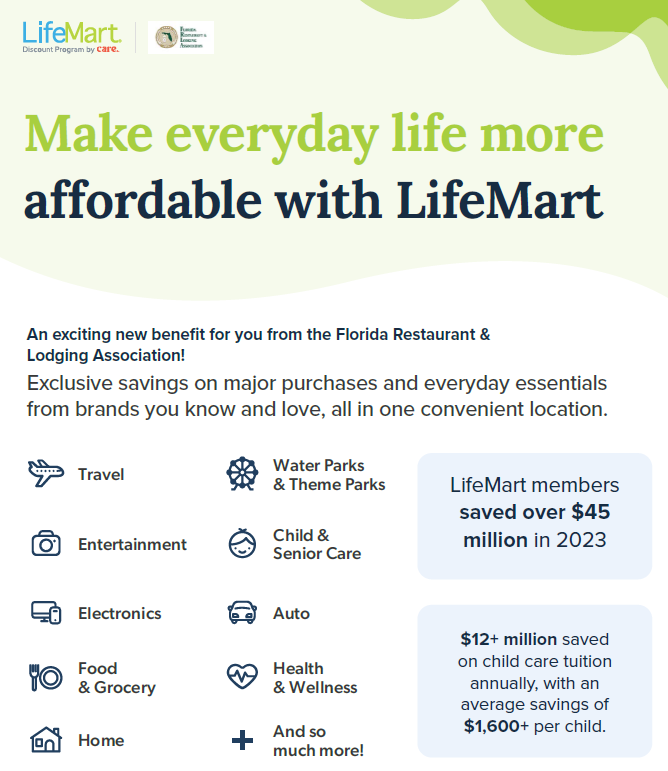
Make Everyday Life More Affordable with LifeMart

FRLA is excited to announce a new, high value benefit for your employees via Care.com and LifeMart. 

The Florida Restaurant & Lodging Association  has partnered with the LifeMart discount program to provide your employees access to exclusive savings on major purchases and everyday essentials from brands your employees know and love, all in one convenient location. With unlimited access your employees will enjoy discounts on child and senior care, travel, fitness, electronics, health & wellness and MUCH more. In 2023 alone, LifeMart members saved over $45 million – $12 million of that was on childcare tuition with an average savings of $1600 per child!

The best part? There’s ZERO cost to you or your employees – and there is NO administrative work needed from you. Registration is simple – print & share the attached flyer in breakrooms or environments where your team has access, and your employees can start saving today!

  • High value benefit provided to you as a member for your employees
  • No limit on savings, NO cost to you or your employees
  • Access anywhere, anytime with the LifeMart mobile app

Simply click here to Request a LifeMart Employee Poster, and our support team will email the poster to you!

  •  

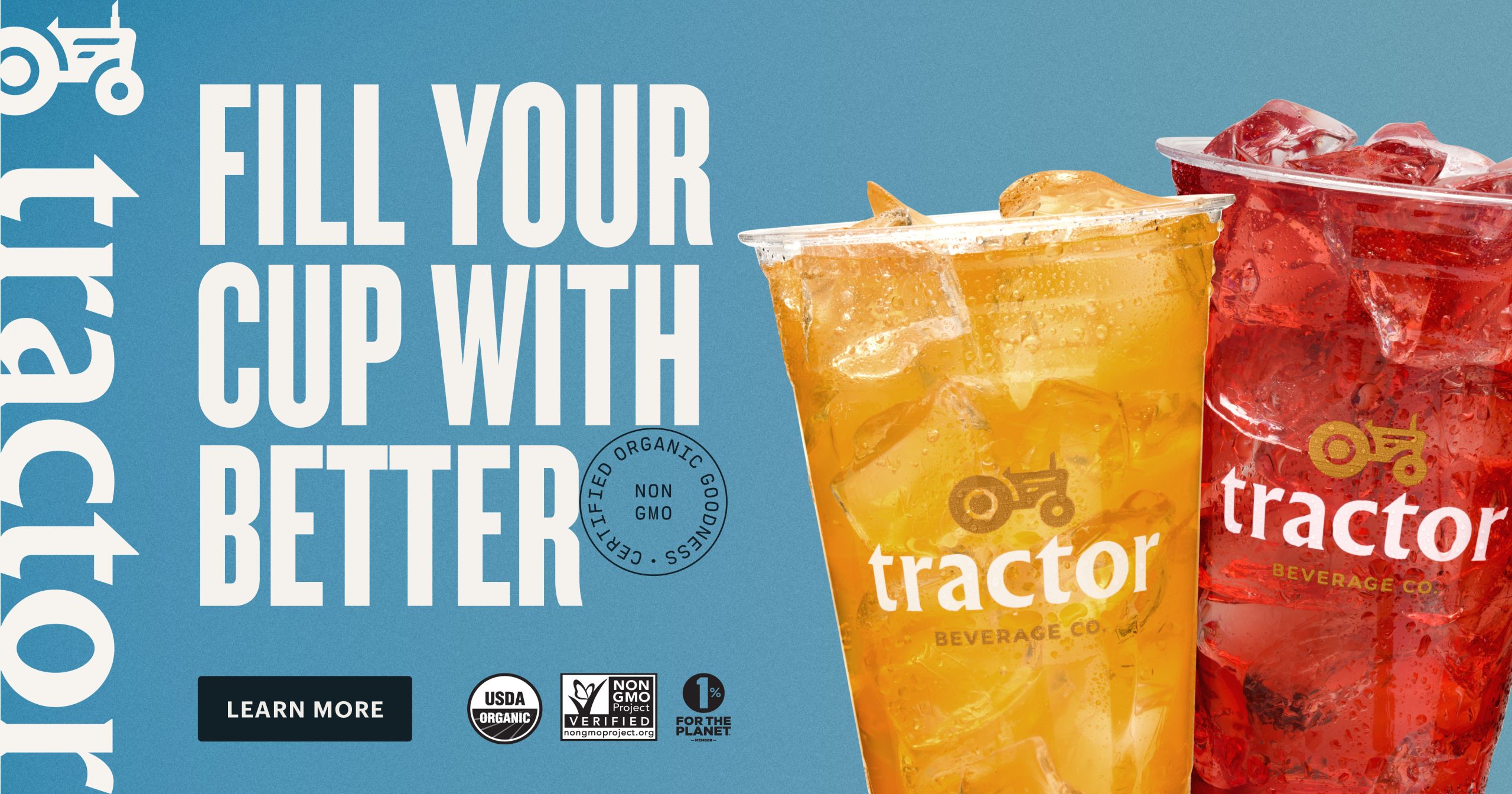
Tractor Joins 1% for the Planet for Earth Month

This Earth Month, Tractor Beverage Co., a certified organic and non-GMO total beverage solution, is taking a monumental step forward in its commitment to environmental stewardship. We’re thrilled to announce our exhilarating new partnership with 1% for the Planet, an alliance that’s as natural as the ingredients in our drinks.


At Tractor, we believe that great food deserves equally great drinks, which is why our eco-conscious products boast a variety of diverse flavors designed to complement any meal and significantly elevate the dining experience. Our mission extends beyond quenching thirst—it’s about contributing to a healthier planet. Partnering with 1% for the Planet marks a significant stride in the collective journey towards a more sustainable future, demonstrating our dedication to making a positive impact on the environment.


Being Responsible Never Tasted So Good


Our partnership with 1% for the Planet aligns with our ethos of working with like-minded entities. It’s not just about offering tasty beverages—it’s about ensuring that our business practices contribute to the well-being of our planet. By pledging to donate 1% of our annual sales to environmental causes, we’re joining a global movement of businesses and individuals committed to protecting the earth.


Tractor’s 8.5:1 non-carbonated concentrates and easy-to-use syrups embody our commitment to quality and sustainability. Aseptically processed and packaged for convenience, our concentrates make serving delightful beverages a breeze, whether at events, behind the bar, or at self-serve stations. With each 12-pack of 32 fl. oz. concentrates yielding approximately 28.5 gallons of prepared liquid, the possibilities are endless. Get creative with your bar menu or serve our delicious concoctions frozen as a slushy to add a fun twist to your beverage offerings.


Our syrups, designed for simplicity and efficiency in fountain soda dispensing machines or bar guns, reflect our dedication to excellence. The bag-in-box styling ensures ease of use and interchangeability with other beverage products, promising a premium beverage experience that complements your culinary philosophy.


Elevating the Culinary Conversation, One Sip at a Time


In celebration of Earth Month, Tractor Beverage Co. invites you to join us in this meaningful partnership with 1% for the Planet. Together, we can make a difference in the world, one sip at a time. Whether you’re a large restaurant or a small café, our mission is to support you in making your beverage program more eco-friendly, offering your customers a flavorful, health-conscious experience.


Let’s raise our glasses to a future where every drink not only tastes good but does good. With Tractor Beverage Co. and 1% for the Planet, we’re turning the tide towards a more sustainable and flavorful future. Cheers to making every sip count!


For more information on Tractor Beverage Co. and our partnership with 1% for the Planet, visit our website. Together, let’s make Earth Month not just a celebration, but a way of life.

LEARN MORE HERE

Are you guilty of committing these 5 payroll mistakes?

Of all the tasks it takes to keep your business running, timekeeping and payroll processing are probably the least exciting and most routine. But that doesn’t mean that getting it right is always easy. Or that getting it wrong is no big deal.

Noncompliance with employment, labor and payroll tax laws can put your business under a microscope, and even lead to fines and penalties. 33% of employers make payroll errors, and roughly 40% of small businesses pay an average of $845 a year in IRS penalties because of mismanaged payroll processes.

To keep your business from becoming a statistic and your costs in check, it’s worth auditing your payroll processes to ensure you don’t fall victim these common pitfalls:

1. Poor record keeping and inaccurate data

Like anything else in business, employing and paying workers generates a lot of paperwork. And preserving those records is important. Different federal, state and municipal agencies have rules defining what type of information employers should keep. For example, the Fair Labor Standards Act (FLSA) requires that individual employee’s records include no fewer than 14 different points of identifying information about the worker, the hours they work and the wages they earn.

In addition to guidelines about what type of information employers should gather and store, laws also define how long that data should be kept. For example, the law requires that you hold on to the following documents for at least four years:

  • Timesheets

  • Canceled checks

  • Tax forms

  • Proof of past payments

It’s also important that employee information be 100 percent accurate. After your employees fill out their W-2s, make sure to double-check the following information:

  • Employee’s full name

  • Current address

  • Social Security Number

  • Start date

  • Termination date (if applicable)

  • Date of birth

  • Payroll details, including hourly rate, overtime, etc.

For a more comprehensive list of labor and payroll tax recordkeeping requirements, visit the IRS’ or DOL’s websites.

2. Falling behind on payroll tax and filing deadlines

Generally the federal government collects payroll taxes on a pay-as-you-go basis. Almost half of all small businesses get fined every year for late or missed payments.

There are several reoccurring payroll tax deadlines you need to remember. A biweekly or monthly deadline is set by the IRS to deposit both withholding taxes and your share of taxes — including federal income tax, Social Security and Medicare taxes, and Federal Unemployment Tax. If you fail to make a timely deposit, you are subject to a penalty of up to 15 percent, depending on how late the deposit is. There are also quarterly and annual returns that you must file with your W-2s. For a complete list, check out the IRS’ website. Also, keep in mind you will likely be responsible for remitting payroll taxes on a state or even local level, which may require different information and/or be due at different times.

3. Withholding errors

There are a lot of potential slip-ups in the withholding process. Misclassifying employees is one common mistake (we’ll get into that more later). Other potential pitfalls include:

  • Failure to withhold federal and state taxes

  • Inaccurate calculation of pre-tax and post-tax deductions

  • Making incorrect deductions from exempt employee’s salaries

  • Excluding taxable fringe benefits like gift cards, awards, and bonuses

  • Excluding specific expense reimbursements from the employee’s taxable wages

  • Issuing incorrect W-2 forms

4. Exempt or non-exempt?

A non-exempt employee (generally an hourly worker) is entitled to overtime pay while an exempt employee is not. When your non-exempt employees work more than 40 hours in a workweek, you owe them time and a half pay for those hours.

An employee must meet three criteria to be exempt from receiving overtime pay:

  • Earns more than $684 per week, or $35,568 annually

  • Is paid a predetermined or fixed salary, that can’t be reduced due to the quality or quantity of their work

  • Primarily performs professional, executive or administrative duties as defined by the law

Employees who don’t meet this criteria are considered non-exempt and owed overtime pay under federal law, no matter the circumstance. For example, if an employee works overtime without advance approval, they’re still entitled to overtime pay. Asking non-exempt employees to work off of the clock, or compensating them with time off in lieu of overtime pay would also result in noncompliance with the law.

Keep in mind we’re only covering federal laws. States and even some municipalities have their own overtime regulations that business owners must also follow.

5. Contractor or part-time employee?

Confusing an employee with a contractor can also cost you. Businesses are generally not required to withhold or pay taxes on payments to independent contractors who are subject to self-employment tax. If workers are your employees, you owe payroll taxes on their wages and taxable benefits. Accidentally misclassifying an employee as a contractor would lead to failure to withhold and remit payroll taxes. Which as we mentioned before, comes with its own set of fines and penalties.

If you are unsure about a worker’s status, you can request an IRS determination by filling out Form SS-8. If you’ve already made the mistake of misclassifying employees, the IRS offers relief through the Voluntary Classification Settlement Program. You can also contact your attorney or legal counsel for advice on how to proceed if you believe you’re noncompliant.

As a small business owner, you’ve got a lot on your plate. The right payroll software will eliminate the confusion and stress that often accompanies paying employees, filing forms and meeting all your tax requirements. Working with a provider that offers SHRM-certified HR professionals to give you a hand whenever you need it is helpful too. Heartland offers these services and more.

So if you’re ready to process payroll and tackle compliance with confidence, we’d love to hear from you. Drop us a line, or check out our website to learn more.

Disclaimer: The information provided in this document does not, and is not intended to constitute legal advice; instead, all information, content, and materials available are for general informational purposes only. Information provided may not constitute the most up-to-date legal or other information, and readers of this information should contact their attorney to obtain advice with respect to any particular legal matter, in the relevant jurisdiction. All liability with respect to actions taken or not taken based on the contents here are hereby expressly disclaimed.


Heartland is the point of sale, payments and payroll solution of choice for entrepreneurs that need human-centered technology to sell more, keep customers coming back and spend less time in the back office. Nearly 1,000,000 businesses trust us to guide them through market changes and technology challenges, so they can stay competitive and focus on building remarkable businesses instead of managing the daily grind. Learn more at heartland.us
Tips for tipping: How to increase employees’ earnings without annoying your customers

Tips for tipping: How to increase employees’ earnings without annoying your customers

The good old-fashioned tip jar that used to proudly sit on counters of businesses across the country seems to be a thing of the past. And it makes sense since the days of customers carrying cash are also largely behind us.

While tip jars might be on their way to becoming a relic of yesteryear, the practice of tipping is still alive and well — digitally, that is. As a result, the way people think and feel about tipping is changing.

But it all depends what side of the counter you’re on.

As a small business owner, you face a dilemma: You want employees to earn more by taking advantage of digital tipping options, but you don’t want to burn customers out. So, how do you strike the right balance? In this article, we’ll get to the bottom of just that.

Follow along as we dive into how attitudes around tipping have changed, what drove that change and how configuring tips properly in your point of sale system — and combining it with great service — can help fight tip fatigue, increase employees’ earnings and keep customers coming back:

How customers really feel about tipping — and why

Tipflation, tip creeping, guilt tipping, tip fatigue …

New tipping terms are springing up like mushrooms. And much like mushrooms, it’s a divisive topic. One that people have strong opinions about.

As a restaurateur, if you want to build a tipping structure that won’t rub people the wrong way, it’s important to understand those opinions. Let’s unpack your customers’ mindset.

The social experience of tipping: It’s complicated

Where leaving a tip was once a voluntary act of generosity and goodwill, today’s tipping can feel more like an anxiety-inducing guessing game. To put it bluntly, it’s complicated.

Not sure what we mean? Here’s a scenario to help explain:

Let’s say Bob orders a latte at his local coffee shop. The employee working behind the register takes his order without so much as a smile or hello. Then, the inevitable happens. The iPad swivels toward Bob with a series of tip options staring back at him.

His mind starts to race:

  • Do you tip a barista the same as you’d tip a waiter at a full-service restaurant?

  • Should you tip the same percentage for a to-go coffee as you would for a sit-down meal?

  • Does the quality of service impact your tip anymore?

  • Would you have tipped for this service five years ago?

The line behind Bob grows restless. He doesn’t want to look bad (even if it was lackluster service), so he begrudgingly accepts the first suggested tip amount he sees, blindly tapping his finger in a panic.

As he walks away, Bob gets a sinking feeling. He really didn’t mean to tip that much. But between the imploring eyes of the cashier and the line of waiting customers breathing down his neck, he felt pressured into it. Bob sips his cup of coffee — and sighs. After all that, his order came out wrong.

As a restaurateur, the last thing you want is for your customers to leave your restaurant with a bad taste in their mouth. But all too often, Bob’s experience is the status quo in 2023. As a Forbes study revealed, one in three people now feel pressured to tip, while 18% feel uncomfortable about tipping.

The question is, why?

Smiling barista hands customer coffee as he pays with card at the point of sale and answers tip prompts.

A brief timeline of tip fatigue

In recent years, the practice of tipping has expanded beyond traditional venues to quick service restaurants, curbside pickups, coffee shops, ice cream parlors, concession stands, movie theaters and more. Although tipping is nothing new in the US, developments over the past few years have changed the game. And no one seems to know the rules anymore.

Icon of person in mask

The pandemic

One big reason for this? COVID-19. Due to the severe hardships placed on workers in the hospitality or service industry during the pandemic, customers were willing to leave bigger tips for more services — services they didn’t normally tip for before the pandemic.

Statistics show tips for full-service and quick-service restaurants surged from 2020 to 2021. This trend seeped into 2022 but lost some steam. Now in 2023, it seems people have reached, well, their tipping point.

Icon of open sign

Post-pandemic

The overwhelming, constant nature of tip requests has led to a wave of tip fatigue. What does that mean? People who would normally be happy to tip are getting tired of it. Research shows Americans are tipping less regularly than they did during the pandemic — and less often than they did prior to the pandemic.

And it’s no wonder. When faced with ever-present tip prompts, people are unsure of when they should actually be tipping and what size tip is appropriate for which services (remember Bob?).

But regardless of the murky guidelines, customers still feel obligated to leave a tip. Which can stir up negative feelings on the lower end of the scale and cause customers to call it quits on tipping altogether on the more severe end.

Icon of value of money decreasing

Economic pressures

On top of that, after years of generous tipping finally taking their toll, rising inflation and a looming economic recession have arrived on the scene. With economic pressures cutting into purchasing power, people are growing more budget-conscious than usual.

Icon of online ordering

Declining service

One more factor driving tip fatigue? Poor customer service. Due to ongoing labor shortages, it’s a serious challenge for understaffed businesses to provide high-quality service while trying to keep their heads above water.

We get how difficult it is. But in customers’ eyes, not only are they being asked to tip more, but they’re being asked to do so in exchange for less-than-satisfactory service. And at the end of the day, it’s not a good recipe for inspiring big tips — or customer loyalty.

The digital experience of tipping: A tale of technology and tipflation

Perhaps the biggest contributor of all to our changing tipping culture is technology.

Swiveling point of sale touch screens and kiosks rose to popularity due to the demand for contactless digital payment options during the pandemic. Since then, far from reverting to pre-pandemic ways, technology-based tipping is here to stay. Tip requests, or suggested gratuity, seem to be everywhere you go — and it has fundamentally transformed the way we tip.

For businesses, digital tipping is a great opportunity to bring in more revenue for employees. For customers, it’s a little less rainbows and sunshine.

Many customers feel that while they’re already taking the hit of higher prices for goods and services due to inflation, they’re being asked to give even more with the inescapable tip prompts at the end of their transaction. Tip prompts that often ask for larger tips than usual (sometimes starting at 20% and reaching 35%). The result? One study revealed 65% of people tip at least 10% more when they tip digitally than they do with cash.

If you’ve been wondering what exactly tipflation is, this is it.

Here’s one more way to look at how tipping has changed: Instead of tipping being an activity the customer opts into as it has been in the past, it’s now an activity they have to opt out of. Why? Screens require customers to make a tip choice in order to complete checkout if they’re paying with credit card or debit card. In other words, there’s no way around it.

It’s easy to see why customers have mixed feelings about tech’s role in tips. But the moral of this story isn’t to avoid using technology for tipping at your restaurant. It’s to be considerate of how your patrons are feeling and to learn how to use technology in the right way. Speaking of…

How to find the right balance for configuring tips at your restaurant

Although customer attitudes towards tipping have seen better days, your employees still rely on tips. Which begs the question: What can you do as a small business owner to max your employees’ earnings without driving customers away?

Glad you asked.

Communication is key

We don’t have to tell you: Tips make up a large portion of your waitstaff’s salaries — especially if they’re getting paid a minimum cash wage. At the federal level, the minimum cash wage is $2.13/hr. However, this might look different depending on where you live since certain states have their own requirements.

A good amount of customers are generally familiar with this concept. But what they don’t always realize is that tips often benefit more than just their server. With tip sharing and tip pooling, other members of staff who are not tipped directly by the customer (think hostesses, bussers, food runners, etc.) may rely on shared server tips too. At some restaurants, they even leave separate line items for patrons to tip their server and the kitchen.

No matter how you decide to distribute tips at your restaurant, doing this one thing will save you a lot of headaches down the road: Communicate your tipping policy to your patrons.

If customers are hit with tip requests for multiple groups or are unsure about where their tip money is going (and are already struggling with tip fatigue), they probably won’t feel too warm and fuzzy about leaving one at your restaurant. That’s why it’s a good idea to educate customers about who exactly receives tips on your staff and why. Chances are, they’ll be less likely to feel blindsided and more likely to tip willingly thanks to your transparency.

Bottom line? Customers don’t want to feel they’re being taken advantage of or hoodwinked into doing something.

Customer uses their watch to pay with digital wallet at the point of sale.

Understand your customers’ motivations

Despite the grumbling and griping, people (for the most part) are probably still going to leave a tip. A study on US tipping culture in 2023 reports that 95% of respondents say they tip at least some of the time, while 76% report always tipping. The top motivations for tipping include:

  • Helping service providers
  • Rewarding servers for their effort
  • Encouraging good service for the next visit

  • Gaining social approval (from observers and servers)
  • Abiding by social norms or fulfilling a social obligation to avoid disapproval

This tells us a few things. First, customers generally understand how little service workers get paid, and they want to help. They also see tipping as a fair exchange for good service.

Second, there’s a social element attached to tipping. And modern payment systems make tipping more of a public affair than ever before. Since those screens aren’t exactly shielded from curious eyes, that means customers have to declare how generous they’re feeling to everyone who has a view of the point of sale … which plays into the societal pressure to tip well.

The takeaway? Different customers have different motivations for tipping, but it’s important to be aware of them. They’ll help you better understand where your patrons are coming from — and make an informed tipping strategy.

You have options: Service charge vs. suggested gratuity

So, we’ve established that employees need tips and that customers generally want to tip. But how to handle it the right way? There’s no cut-and-dry answer, but you can make informed decisions based on your restaurant type and customers.

Your three main options are to:

  1. Leave an open-ended tip line with no suggested tip

  2. Include a set tip via a service charge or automatic gratuity

  3. Provide suggested tips via prompts on the point of sale screen or receipt

So, which one to choose? A survey shows that 63% of customers prefer free discretionary tipping over included service charges. However, take that with a grain of salt.

Icon of receipt with service charge

Service charges

If you’re not familiar, a service charge is when a server’s or bartender’s tip (usually around 18%) is included in the bill.

For some restaurants that pride themselves on exceptional hospitality, like fine dining or higher-end establishments, automatic gratuity often is the best course of action to ensure waitstaff is well taken care of. Another instance where this might make sense is for larger parties —usually of six or more guests. Again, this is to protect the server from doing taxing work without proper payoff.

If either of these situations applies to your restaurant, you’ll want to do as we discussed earlier and communicate about it with your customers. Sneakily slipping a service charge into the total amount without telling your customers won’t work in your favor. Adding a tip prompt on top of that definitely won’t. Double tipping only leads to angry customers. Best to avoid it from the start!

Icon of person requesting tip

Suggested tips

If you choose to go with suggested tip amounts, the same rules apply: Be upfront and honest.

For example, if you provide a few different tip amounts on the screen, but the default, preselected amount is 30%, a customer might accidentally select that and feel they’ve been tricked into it. And the employee is usually the one who will face the brunt of the backlash over it. It’s a good idea to leave suggestions in a way that doesn’t promote one option over another. After all, tipping should be the customer’s choice.

Now, let’s get into the weeds of different ways to configure suggested tip amounts based on price points, the kind of restaurant you run and the structure that makes the most sense for you.

Icon of paying for percentage of a pizza

Percentages

Percentage-based tipping is most common for sit-down restaurants. Diners in these types of restaurants are already used to tipping their server 15-20% of their total bill due to the waiter’s continuous service throughout their meal.

With modern point of sale systems, you should be able to customize your suggested gratuity percentages — and calculate them either with or without tax included. A common method is to suggest 10%, 15% and 20% options. But if your restaurant is a little more upscale, a 20%, 25% and 30% range might suit better. Keep your average customer in mind, as well as the average price of your menu items when selecting suggested percentages.

One more thing to consider — if you go the percentage route, it’s also a nice touch to include the dollar amount the percentage equates to on the screen or receipt. Most customers will appreciate not having to pull out their smartphone calculators to do the math themselves.

Icon of cash flow

Fixed dollar amounts

As far as fixed dollar suggestions go, this option is most widely adopted by quick service restaurants, coffee shops and bars.

Here’s why: If you run a coffee shop and your customers are regularly making low-dollar purchases, suggesting simple dollar amounts instead of percentages might yield better results for your staff.

These suggestions often look like $1, $2 or $3 tips for a coffee that costs around $5. A customer would probably balk at a 50% tip but look at leaving an extra $2.50 as not so bad. See the appeal?

Icon of online ordering app

Combination

We get it. It’s not always black and white. If your restaurant offers a wide range of menu prices or varies greatly depending on the time of day (perhaps you have a low-dollar lunch menu but increase prices for the dinner crowd), you may want to take a mixed approach.

This is when you alternate between suggested percentages and fixed dollar amounts for tips based on whether a purchase is above or below a certain price point. For example, you could set fixed-dollar gratuity suggestions for anything below $10, but change to percentages for anything above $10.

Whichever tipping strategy works best for your restaurant, here’s the golden rule: Be transparent with your customers, and don’t try to manipulate them with suggested tip ranges that will likely be out of their comfort zone. You might get a higher tip that one time, but will you get a repeat visit?

Smiling waiter takes tableside payment from customer with mobile point of sale system.

Great service trumps all

We saved the best tipping tip for last: The most foolproof way to get customers to tip well (and gladly) is to deliver great service. As it happens, that’s also the best way to get them to return to your restaurant.

Easier said than done, right? If you’re wondering how to train employees to provide great customer service, take a page out of Danny Meyer’s book and explore his top strategies for creating a culture of stellar hospitality.

Another piece of the puzzle? Let your employees know why they should deliver a great customer experience.

While some members of the younger workforce who are more accustomed to the digital age may expect a tip regardless of the quality of service, the research says otherwise.

According to one study, nearly 80% of participants said the size of their tip was directly proportionate to the service they received. This goes to show tipping is subjectively determined by the quality of the service.

Be sure to adjust your employees’ expectations during training — and let them know this is ultimately good news. Why? Because it gives them autonomy over their situation and empowers them to make a significant impact on the size of their tips through performance.

If your staff starts to implement small behaviors like increasing their number of visits to the table to check in, smiling, repeating customers’ orders after writing them down and exhibiting kindness and attentiveness — they might just tip the scale in their favor.

How technology can help

Keeping both customers and employees happy in general is difficult. It’s an even finer balance when it comes to tipping. But there’s no reason why you should navigate it alone.

Using the right technology in the right way can help your restaurant beat tip fatigue, increase employee earnings, keep customers coming back — and do it all without breaking a sweat.

Meet Heartland Restaurant point of sale. Our point of sale systems offer secure tip management features that make it easy to accept tips at the time of sale, collect post-authorization tips and track tips throughout shifts. Our tech also helps you take care of your people with secure tip cards, payout apportions, tip pooling and convenient server banking.

With Heartland Restaurant, you can:

  • Ensure staff is rewarded for great service: Make it simple to add a tip with a sleek, customer-facing touchscreen. Users can choose between two different types of tipping styles — or not tip at all.

  • Enable onscreen tipping: Customize suggested tip options and allow customers to make a tip selection before paying. Display a screen on the payment device where the customer can select their desired tip, whether it’s a suggested tip amount, a custom amount or no tip. You can also capture customers’ signatures on-screen or via a paper receipt.

  • Offer receipt tipping: Take a payment, then allow customers to add a tip later (also known as “Tip/Adjust”). You can print separate receipt slips for the merchant and customer, including tip and total lines, plus a line for the customer’s signature.

Best of all, our restaurant point of sale tech comes in different pricing plans, built for every budget.

Ready to unlock solutions that make every day work better for you, your customers and your employees? Learn more here.


Heartland is the point of sale, payments and payroll solution of choice for entrepreneurs that need human-centered technology to sell more, keep customers coming back and spend less time in the back office. Nearly 1,000,000 businesses trust us to guide them through market changes and technology challenges, so they can stay competitive and focus on building remarkable businesses instead of managing the daily grind. Learn more at heartland.us

4 Reasons to Add Tech Solutions Like Fintech to Your Restaurant

Restaurants are gearing up for the busy holiday season. In preparation, operators are looking for areas to make improvements, considering rising labor demand, costs, and competition. Managers can improve operations by implementing tech solutions that automate manual tasks and drive higher return on investment (ROI).
Operators may think they need a catch-all solution that tackles everything at once, but there are more cost-effective solutions that improve the customer experience and protect the bottom line. Fintech’s PaymentSource® targets restaurants’ beverage alcohol management by streamlining tasks to save both time and money that can be invested in other areas of the business.


1) Maintain Consistent Margins

There isn’t always room in the budget for investing in a high-tech solution, especially when margins are tight from rising costs. The National Restaurant Association (NRA) published a report earlier this year that projected $997B in sales for the foodservice industry, so while revenue is expected to increase, that means finding ways to keep pace with the demand. There is also an emphasis on finding products with the highest ROI to improve margins.

Fintech’s PaymentSource has detailed reporting features that help restaurants improve buying strategy and stay competitive. One example is the Cost Variance Report, which tracks fluctuations in product costs so restaurant operators can take action to protect margins. The Top Products Report determines fast-moving products to take advantage of quantity buys and ensure the right selection is stocked in line with consumer demand. For restaurants burdened by split case fees, the Split Case Report identifies money lost in the ordering process and pinpoints when to order or buy the case or the bottle.

These cost savings and margin-enhancing reporting tools will preserve more of the restaurant budget that can be invested elsewhere.

2) Save Time With Automation

Wasting time on manual tasks is an efficiency killer in the restaurant industry. Managers have to stop what they’re doing to handle payment for each alcohol delivery, then have to take more time to manually input line-item invoice details into the restaurant back-office or accounting system. Wouldn’t it be better to have technology in place that automates alcohol invoice payments with each distributor? Wouldn’t it be even better to have technology that also seamlessly integrates line-item invoice data without having to lift a finger?

Fintech helps restaurant operators with both. Alcohol invoice payments are paid in compliance with state regulatory terms for beer, wine, and spirits. There is also an electronic data interchange (EDI) component that integrates with over 200 back-office systems like Quickbooks, Restaurant365, Compeat, and more.

These automations allow operators to receive their delivery and get back to business with minimal interruptions.

3) Reliability

It is no secret that turnover is high in the restaurant industry. This turnover slows down operational efficiency and leaves managers scrambling to interview, hire, and train new employees. Employing technology solutions that automate tasks provides consistency in key areas. With reliable technology in place, there is one less area to worry about “no call/no shows,” employees calling out on busy shifts, and high turnover rates.

Reliability is a great trait in restaurant workplace culture, and Fintech has yet to miss an alcohol invoice payment, call in sick, or request a day off.

4) Enhance the Customer Experience

The restaurant industry is built around hospitality. The biggest driver of success is ensuring customers have a positive experience that keeps them coming back. Restaurant operators shouldn’t be bogged down with manual tasks that keep them in the back office, they should be out on the floor with customers and helping their staff.

While some may argue that more automation in restaurants limits human interaction, there are certainly some forms that foster more human interaction. With a system like Fintech running in the background, restaurant operators can put more time and energy into the customer experience versus dealing with time-consuming manual tasks.

Restaurants Should Use Technology to Their Advantage

With so many moving parts in successful restaurant management, a helping hand goes a long way. Restaurants can leverage technology solutions like Fintech to streamline their beverage alcohol program. Operators should take the little time left before getting into the full swing of the holiday season to identify solutions that protect and improve margins, build better purchasing strategies, and deliver better experiences to their customers.

Written By: Matthew Bruner

Natural Gas: Limitless Opporunity

Limitless Opportunities Await With Natural Gas. Increase Your Bottom Line and Customer Satisfaction

Whether you’re new to natural gas or you’re already enjoying its many benefits, now is the time to maximize your savings. Natural gas is a reliable, domestic, and environmentally friendly energy source, fueling a large variety of applications in the restaurant and lodging industries. And with high-performance natural gas equipment, you can save money on operational costs and reduce your carbon footprint — all while keeping your customers satisfied.

  • Reduce your operational costs
  • Improve business efficiency
  • Decrease your carbon footprint
  • Boost your bottom line
  • Save money for other business expenses
  • Contribute to the U.S. economy

Explore the many benefits of natural gas, plus start saving right away with equipment rebates that may be available through your local utility provider.

START SAVING WITH RELIABLE NATURAL GAS